


Object of the Month
Every month we highlight a special object from our collection at the Natural History and Ethnographic Museum. From fossils to folklore, from animals to everyday objects: each object tells its own story. See below which objects have already been featured in 2025.
 April 2025
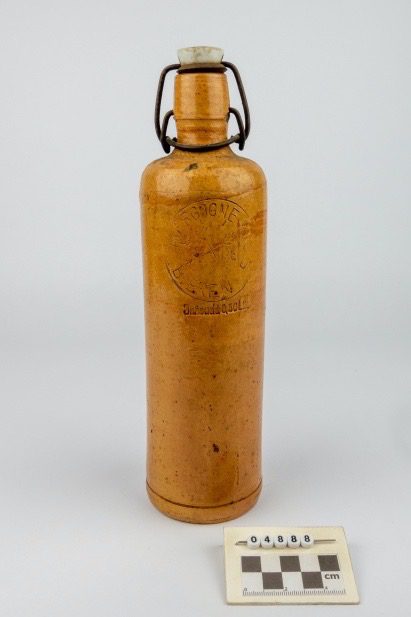
Beer from Oudenbosch
This year Oudenbosch celebrates its 750th anniversary, and we at the Natural History and Ethnographic Museum are celebrating our 40th anniversary. In our collection we have a beer jug with a swing-top closure from brewery “Het Bourgogne Kruis” in Oudenbosch. Antonius van den Bemd, a baker, bought a malthouse and residence on Wagenhoek in 1920, where his sons Jan and Gerard started a beer brewery in 1922. They named their brewery Het Bourgogne Kruis, which is a diagonally placed cross made of two gnarled sticks. This name should not be confused with “Het Bourgondisch Kruis”, which was a brewery in Oud-Gastel that brewed beer from 1771 to 1921.
Het Bourgogne Kruis sold bottom-fermented brown beer of 3.5 to 4 percent alcohol by volume in stone jugs of 50 centiliters. After World War II, the brewery introduced Knock-out pale ale, a strong beer of 6.5 percent. The name pale ale sounds quite popular nowadays with the great variety of all kinds of IPA “s. Pale Ale” s are beers brewed with predominantly pale malt. Reportedly, brewing this ale was a response to the Franciscaner beer from brewery “Het Anker”, also located in Oudenbosch. In 1952, brewing stopped and Jan van den Bemd moved to New Zealand. His son Frans continued as a beverage dealer.
Grandson Jan van Bemd was one of the founders in 2009 of a renewed Bourgogne Kruis brewery, this time located in Oosterhout. Het Bourgogne Kruis was one of the seven breweries that Oudenbosch was rich in.
In the center of Oudenbosch, several streets are still named after the old breweries: Bourgognekruisstraat, Ankerstraat, Leliestraat, Ringstraat and Brouwerijstraat. These streets are located behind our museum.
March 2025
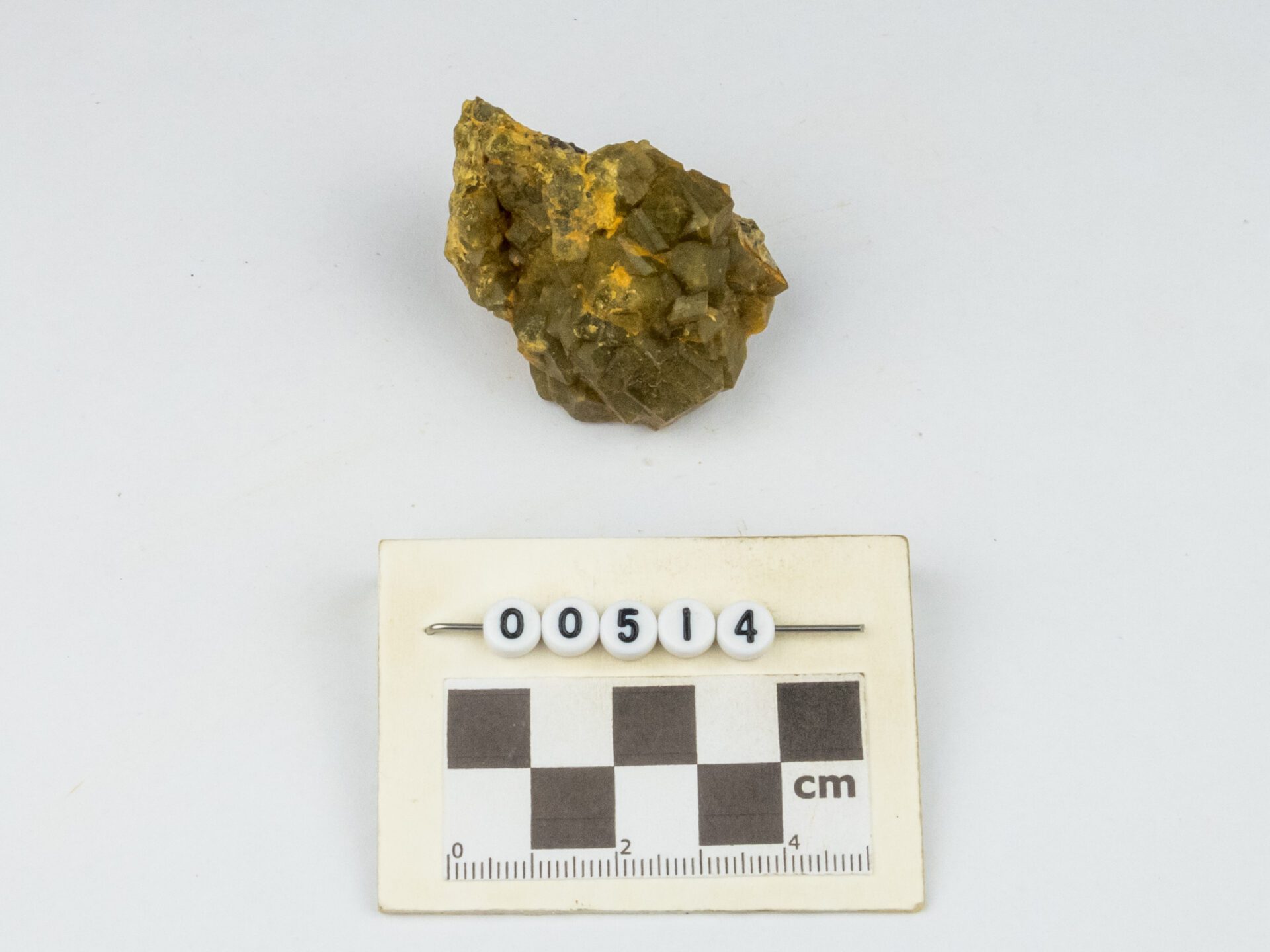
Grossular
If someone shouts during a vacation to go look for grenades, it’s quite startling. Geologists, however, wouldn’t be surprised. Garnet is a group of minerals with a cubic crystal system. All types of garnets have similar physical properties and crystal forms, but differ in chemical composition. The different types are pyrope, almandine, spessartine, grossular, uvarovite and andradite.
Garnet varieties can be found in many colors, including red, orange, yellow, green, blue, purple, pink, brown, black and colorless. The reddish tints are most common and best known; they are used in jewelry, among other things.
The mineral garnet is often found in metamorphic and to a lesser extent igneous rocks. An igneous rock is liquid rock spewed out by volcanoes that has hardened as lava. Metamorphic rock is rock in our earth’s crust that changes composition due to high pressure or temperature changes, for example.
A variety of garnets is hessonite, which we also know under the name grossular. The name grossular comes from “ribes grossularia”, Latin for gooseberry. Grossular occurs in various colors: brown, red, colorless and green. It is formed in calcareous rock through metamorphism, but can also be formed by hydrothermal processes in fractures of calcareous rocks. It is a calcium-aluminum silicate, which explains that calcareous rock is needed to form it. In cut form it can easily be confused with more expensive gemstones, but the specific gravity then provides a solution to recognize them. This hessonite comes from Brazil. This country is, after Sri Lanka and India, one of the important locations for this garnet variety.
Garnet varieties have been used in jewelry and as abrasives since the Bronze Age. The transparent specimens are then often cut as gemstones, while opaque garnets are used for industrial purposes.
February 2025
The Muskrat
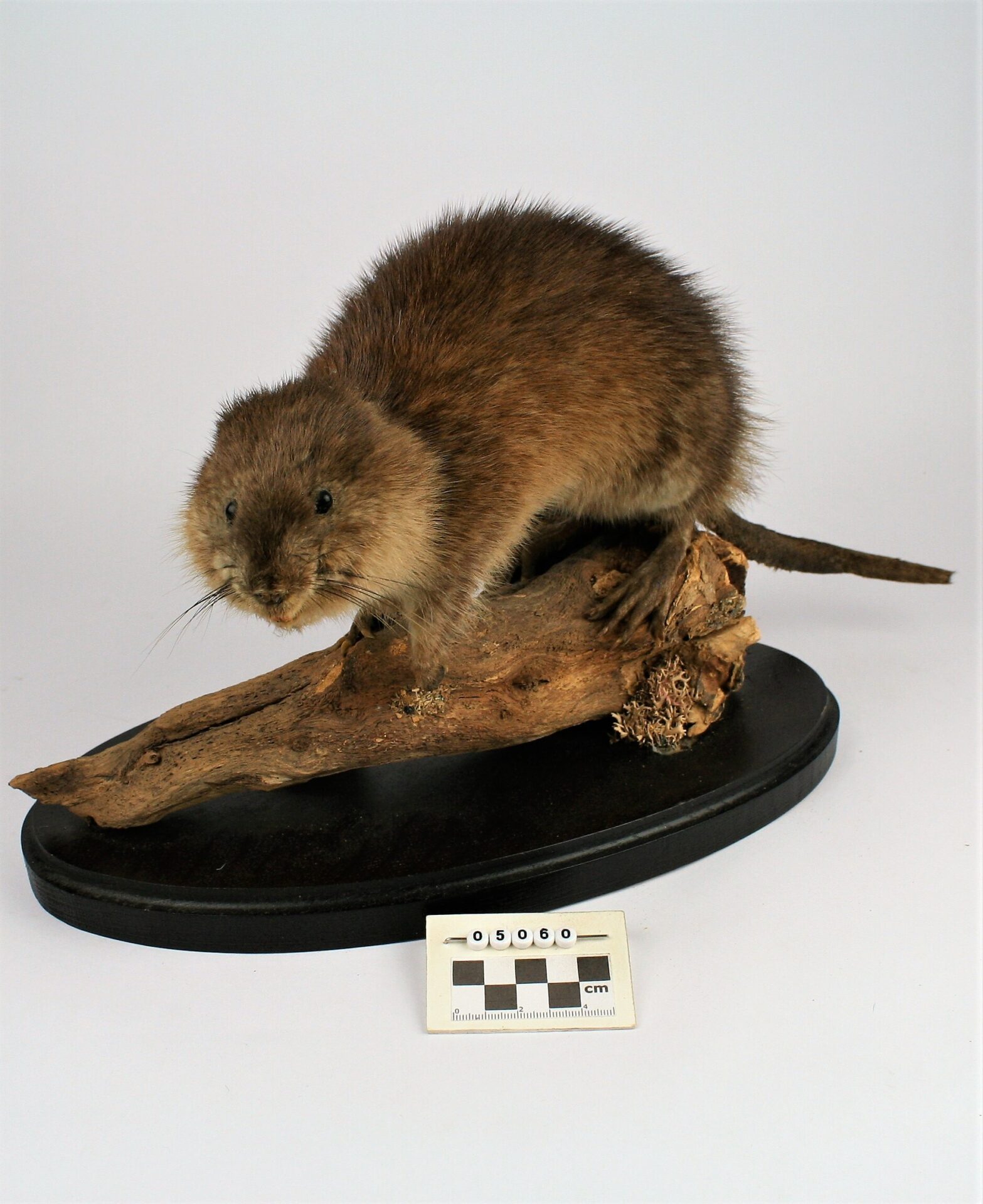
Will we only see this cute little animal in museums in the Netherlands in about ten years?
The muskrat is a rodent originally from North America. Contrary to what the name suggests, the animal does not belong to the rat family, but falls under the voles. In our nature hall, a skull of a muskrat can be seen, where the incisors are clearly visible. Czech Count Colloredo-Mannsfeld brought some muskrats back from a hunting trip through Alaska. The pelts were sought after as fur, and thus muskrats spread across Europe for over a century. Via Belgium, the animal migrated to the Netherlands. In the area around Budel, a muskrat was caught for the first time in our country in 1938.
Since 2017, the muskrat has been on the list of invasive alien species that are of concern to the European Union. The animals can cause significant damage by digging tunnels in our dikes, which in the worst case can lead to dike breaches. The animals are also a threat to biodiversity. Muskrats and nutria eat reeds and cattails, for example, which is a biotope for native animals. Control was formerly a task of provinces, but is now a task of water boards. In our province, fewer muskrats are caught than in the center of the country, but in West Brabant we do have many rivers and streams with dikes and embankments that must be protected.
Last month there were reports in the news about control efforts. Last year in the Netherlands, thousands more muskrats and nutria were caught than the year before. In Germany, the population is still extensive, due to mild winters and less well-organized control. During high water in Germany, the burrows of the rodents there were flooded and they moved downstream to the Netherlands in search of dry places. The water boards want the Netherlands to be virtually muskrat-free by 2034. The goal is achieved if fewer than 500 muskrats per year are caught inland by that time.
To investigate whether muskrat control can be more efficient and with less animal suffering, the Brabantse Delta water board conducted a scientific field study in the rural area of Dinteloord. Muskrats have not been controlled here for several years, to investigate the effect. The research was completed in 2017, and the research results are being used to determine a new approach for muskrat management. The protection of the rural area and repair of any damage has always been paramount in the research.
January 2025
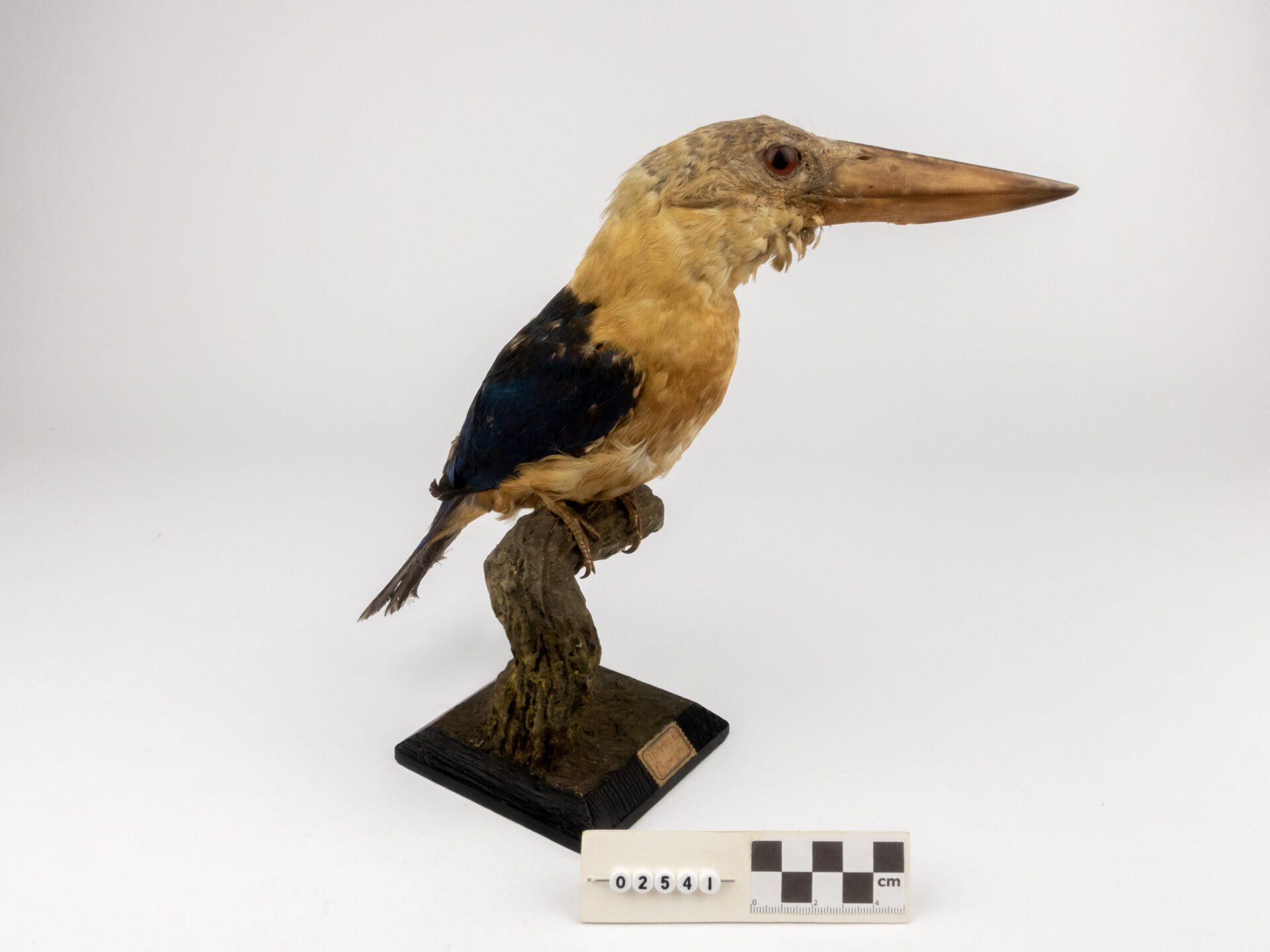
THe Stork-Billed KingfisheR
The stork-billed kingfisher.
In our collection are a number of strange birds. For example, this specimen. Small body with a blue back and a distinctive large beak. What could this be? The label states that the little bird comes from Sumatra. It belongs to the family with the Latin name Pelargopsis. This is a genus of tree kingfishers found in southern Asia. The type species is a subspecies of the stork-billed kingfisher Pelargopsis capensis javana. The Greek word Pelargos means stork.
The naming of kingfishers is sometimes unfortunate. In Dutch, according to its name, it seems to like the cold. However, these animals cannot tolerate cold well and occur mainly in tropical and temperate regions of the world. In English it has been given the name kingfisher. There are indeed several species of kingfishers that specialize in catching fish, but certainly not all species. Other small animal species such as crustaceans, amphibians and insects are also on the menu.
In the Netherlands we know the kingfisher as a little animal with a yellow belly and blue head and feathers. Worldwide there are 118 species divided into three subspecies. Within this species richness there are large differences in color. Sometimes white, but all colors of the rainbow occur. The stork-billed kingfisher lives along rivers, lakes or coasts. They are very territorial; they don’t hesitate to chase large predators like eagles away from their habitat. They build their nests, just like the kingfishers more familiar to us, in the banks along the water.
 Stay connected
Receive the Latest News
and Exclusive Updates!
Reserve your Tickets Now and Immerse Yourself in the Wonders of Nature and Culture!